Category: Blog

Your blog category

  • Why Clarity Beats Speed

    Many leaders believe speed creates success.

    But speed without clarity creates chaos.

    Teams don’t fail because they move slowly.
    They fail because they move in different directions.

    Clear priorities reduce confusion.
    Clear expectations reduce mistakes.

    When direction is obvious,
    speed naturally follows.

    Clarity first.
    Speed second.

    That’s how strong systems are built.

  • What AI Taught Me About Leadership

    AI taught me something interesting.

    Speed is easy.
    Clarity is rare.

    The more tools I see,
    the more I realize leadership is not about doing more.

    It’s about choosing better.

    In a world full of automation,
    clear direction becomes power.

  • The First Step to Becoming a Better Leader

    If I had to summarize leadership in one sentence:

    Design systems that make success repeatable.

    Not louder speeches.
    Not more motivation.
    Not more pressure.

    Just clarity, consistency, and structure.

    That’s where real leadership begins.

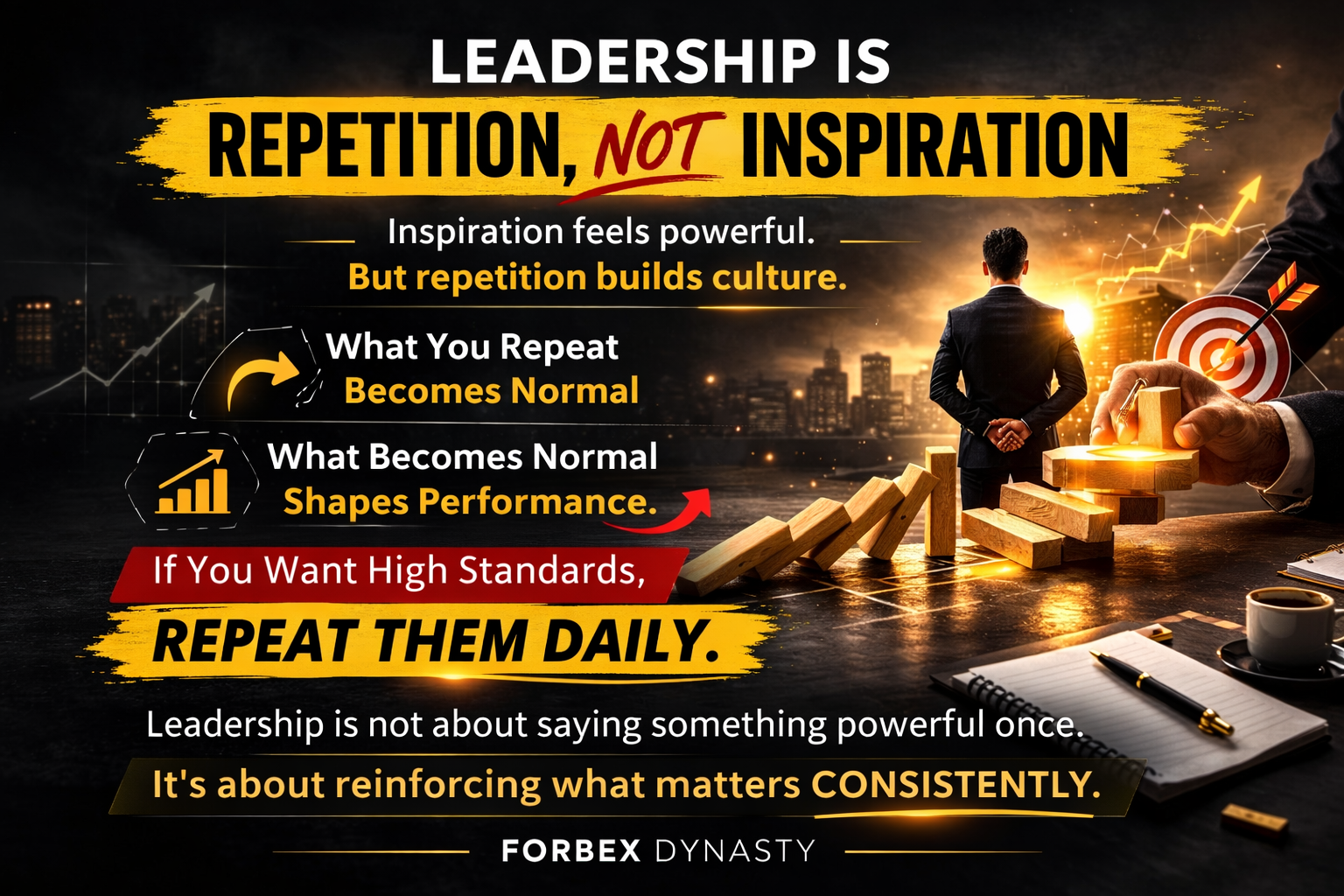
  • Leadership Is Repetition, Not Inspiration

    Leadership Is Repetition, Not Inspiration

    Inspiration feels powerful.
    But repetition builds culture.

    What you repeat becomes normal.
    What becomes normal shapes performance.

    If you want high standards,
    repeat them daily.

    Leadership is not about saying something powerful once.
    It’s about reinforcing what matters consistently.

  • From Manager to System Thinker

    Managers control tasks.
    System thinkers design outcomes.

    A manager asks,
    “Did you finish it?”

    A system thinker asks,
    “Why does this process fail?”

    Leadership evolves when you stop reacting
    and start designing.

    If you are solving the same problems every week,
    you don’t need more effort.
    You need a better system.

  • Log Badi Baaton Par Nahi, Daily Action Par Trust Karte Hain

    Aaj ke time me har koi bol sakta hai:
    “Main serious hoon.”
    “Main long-term ke liye kaam kar raha hoon.”
    “Main value dena chahta hoon.”

    Par sach yeh hai —
    log baaton par nahi, action par trust karte hain.

    Aur woh action bhi koi bada event nahi hota.
    Woh hota hai roz ka chhota kaam.


    Badi Baaton Ka Problem Kya Hai?

    Badi baatein sunne me achhi lagti hain,
    par unka ek problem hota hai:

    • Aaj boli, kal bhool gaye
    • Aaj promise, kal excuse

    Isliye log dheere-dheere
    baaton par bharosa karna chhod dete hain.


    Daily Action Trust Kaise Banata Hai?

    Daily action ka matlab hai:

    • Roz thoda kaam
    • Roz same direction
    • Roz same level ka effort

    Jab log dekhte hain ki:

    “Yeh banda roz aa raha hai,
    bina noise ke kaam kar raha hai”

    toh trust automatically build hota hai.


    Consistency Skill Se Zyada Powerful Hai

    Sach yeh hai:

    • Average skill + high consistency = strong trust
    • High skill + no consistency = zero trust

    Log us par bharosa karte hain
    jo predictable hota hai.

    Unhe pata hota hai:

    • Yeh kal bhi dikhega
    • Yeh apna kaam karega

    Business Aur Personal Brand Me Yeh Kyun Important Hai?

    Business ho ya personal brand —
    dono trust par chalte hain.

    Agar tum:

    • Kabhi active, kabhi gayab
    • Kabhi clear, kabhi confused

    toh log tumhe follow nahi karenge.

    Par agar tum:

    • Roz same message
    • Roz same effort
    • Roz same intent

    dikhate ho —
    toh log rukte hain, padhte hain, sunte hain.


    Final Thought

    Log impress nahi hote,
    log sure hona chahte hain.

    Sure ki tum:

    • Kal bhi kaam karoge
    • Next week bhi dikhe rahoge

    Isliye yaad rakho —
    log badi baaton par nahi, daily action par trust karte hain.

  • Why Motivation Stops Working After a Point

    Motivation works — but only for a while.

    At the beginning, motivation creates movement.
    But over time, it fades.
    And when it fades, most leaders panic.

    The problem is not people.
    The problem is dependency on motivation.

    Strong leaders don’t depend on daily excitement.
    They depend on systems that work even on low-energy days.

    If performance drops when motivation drops,
    your leadership needs structure, not speeches.

  • Leadership in 2025 Is About Systems, Not Motivation

    Most leaders still believe motivation is the key to performance.
    In 2025, that belief is breaking.

    Motivation is temporary.
    Systems are permanent.

    Great leaders don’t wake up every day trying to inspire people.
    They build systems that make the right action easy — even on bad days.

    When your team performs only when you motivate them,
    you don’t have a leadership problem,
    you have a system problem.

    Leadership today is not about energy.
    It’s about clarity, structure, and repeatable processes.

    Build systems first.
    Results will follow.

  • 10 Reasons Why Most Startups Fail — And How You Can Avoid It

    🧠 Introduction

    2025 ke era me har mahine hazaron startups launch ho rahe hain — lekin 90% first 3 saal me fail ho jaate hain.
    Kyu? Galti idea me nahi hoti, execution aur mindset me hoti hai.
    Aaj hum jaanenge 10 aise karan jo sabse zyada founders ko crash kar dete hain — aur unse kaise bacha ja sakta hai.

    ⚠️ 1. Lack of Market Research

    Startup shuru karte waqt founder apne idea pe pyaar kar leta hai, market pe nahi.
    Solution:
    Market ke real pain points samjho, Google Trends aur Reddit se feedback lo.

    💸 2. Poor Money Management

    Paise aate hi luxury kharche badh jaate hain — aur 6 mahine baad fund khatam.
    Solution:
    “Runway mindset” rakho — kam se kam 12 mahine ke expense ka backup rakhna.

    🚀 3. Weak Marketing Strategy

    Product acha hai, par logon ko pata hi nahi.
    Solution:
    Digital marketing ko shuru se priority do — content, SEO aur newsletter pe invest karo.

    🧑‍💼 4. Wrong Team Choices

    Wrong co-founder ya unmotivated team poore project ko bigaad deti hai.
    Solution:
    Hire mindset, not only skillset. Shared vision sabse important hai.

    ⚙️ 5. Ignoring Innovation

    Market evolve hota hai — par founder same idea pe atka rehta hai.
    Solution:
    Every 3 months apna product aur process review karo — innovation ko DNA bana lo.

    💥 6. No Real Problem Solving

    Zyada startups “cool product” banate hain, “useful solution” nahi.
    Solution:
    Customer ke daily life problem ko solve karne pe focus karo.

    🕒 7. Lack of Patience

    Result jaldi chahiye hota hai. Jab slow growth milti hai, founders give up kar dete hain.
    Solution:
    Startup = long-term game. Consistency > instant success.

    📊 8. Ignoring Data

    Decision gut feeling se nahi, data se lo.
    Solution:
    Analytics tools aur user feedback ka daily use karo.

    9. Poor Leadership

    Team confused rehti hai, vision unclear hota hai.
    Solution:
    Leader wo hota hai jo inspire kare, control nahi. Transparency rakho.

    🔄 10. No Adaptability

    Change se dar lagta hai — jabki market har 6 mahine badalta hai.
    Solution:
    Har feedback ko seriously lo. Pivot karna failure nahi, growth ka part hai.

    💡 Conclusion

    Startup fail nahi hota, founder give up karta hai.
    Agar tum har mistake ko seekhne ka chance samjho, to success inevitable hai.
    Aaj se ek decision lo → “Main fail nahi, evolve karunga.”

    🧾 Bonus: Free PDF Guide

    Want to learn how to make your startup survive in 2025?
    🎁 Download our Free PDF – 10 Startup Mistakes to Avoid in 2025 and save your dream business before it’s too late 👇

    
    
  • 5 Patterns Every Successful Startup Follows in 2025

    5 Patterns Every Successful Startup Follows in 2025

    While most startups fail, the few that win share surprising similarities.
    Here’s what successful founders do differently in 2025:

    1️⃣ Speed over Perfection

    They launch fast, test faster.
    MVP (Minimum Viable Product) mindset beats perfection every time.

    2️⃣ Community before Product

    Smart startups build an audience first — even before launching their idea.
    Traffic becomes their testing lab.

    3️⃣ Data-Driven Decisions

    They trust data, not assumptions.
    Every campaign, feature, or ad is measured — not guessed.

    4️⃣ Automation & AI Usage

    AI tools cut cost and time. Startups using AI in operations grow 2x faster.

    5️⃣ Resilient Leadership

    Founders who journal, delegate, and recharge — lead better.
    Mental clarity = business clarity.

    💡 Forbex Insight:
    The difference between failing and scaling is iteration speed.
    Don’t chase trends — master execution.


    🔹 CTA: