Trends are attractive.They promise growth.
They promise attention.
They promise relevance.But chasing trends has a hidden cost.Focus disappears.Leaders who chase every new idea
lose the ability to build long-term systems.Innovation does not mean reacting to every trend.
It means choosing the few ideas that truly matter.Discipline is the real innovation advantage.
Author: Forbex Dynasty
-
The Hidden Cost of Chasing Trends
-
Why Clarity Beats Speed
Many leaders believe speed creates success.
But speed without clarity creates chaos.
Teams don’t fail because they move slowly.
They fail because they move in different directions.Clear priorities reduce confusion.
Clear expectations reduce mistakes.When direction is obvious,
speed naturally follows.Clarity first.
Speed second.That’s how strong systems are built.
-
What AI Taught Me About Leadership
AI taught me something interesting.
Speed is easy.
Clarity is rare.The more tools I see,
the more I realize leadership is not about doing more.It’s about choosing better.
In a world full of automation,
clear direction becomes power. -

Innovation Is Not About Technology
Most people think innovation means new technology.
It doesn’t.
Innovation means better systems.
If a process becomes simpler,
that’s innovation.If communication becomes clearer,
that’s innovation.If decisions become faster and cleaner,
that’s innovation.Technology can help.
But structure creates progress.Real innovation removes friction.
-
Leadership in the Age of AI
AI is everywhere now.
Tools are faster.
Information is instant.
Automation is growing.But here’s the truth:
Technology does not create leadership.
Clarity does.In the age of AI, leaders are not valuable because they know more.
They are valuable because they think clearly.When everyone has access to tools,
judgment becomes rare.Leadership in 2025 is not about competing with machines.
It’s about removing confusion for humans.AI can process data.
Leaders create direction.And direction is what teams actually need.
-
The First Step to Becoming a Better Leader
If I had to summarize leadership in one sentence:
Design systems that make success repeatable.
Not louder speeches.
Not more motivation.
Not more pressure.Just clarity, consistency, and structure.
That’s where real leadership begins.
-
The First Step to Becoming a Better Leader
If I had to summarize leadership in one sentence:
Design systems that make success repeatable.
Not louder speeches.
Not more motivation.
Not more pressure.Just clarity, consistency, and structure.
That’s where real leadership begins.
-

What This Month Taught Me About Real Leadership
This month changed how I see leadership.
I used to think leadership was energy.
Inspiration.
Momentum.
Intensity.I was wrong.
Leadership is engineering.
It’s about designing clarity.
Repeating standards.
And building systems that remove confusion.The more predictable I became,
the stronger my leadership felt.Not because I became louder.
But because I became clearer.
When expectations are clear,
performance improves naturally.Leadership isn’t emotional intensity.
It’s structural stability.
And stability builds trust.
-
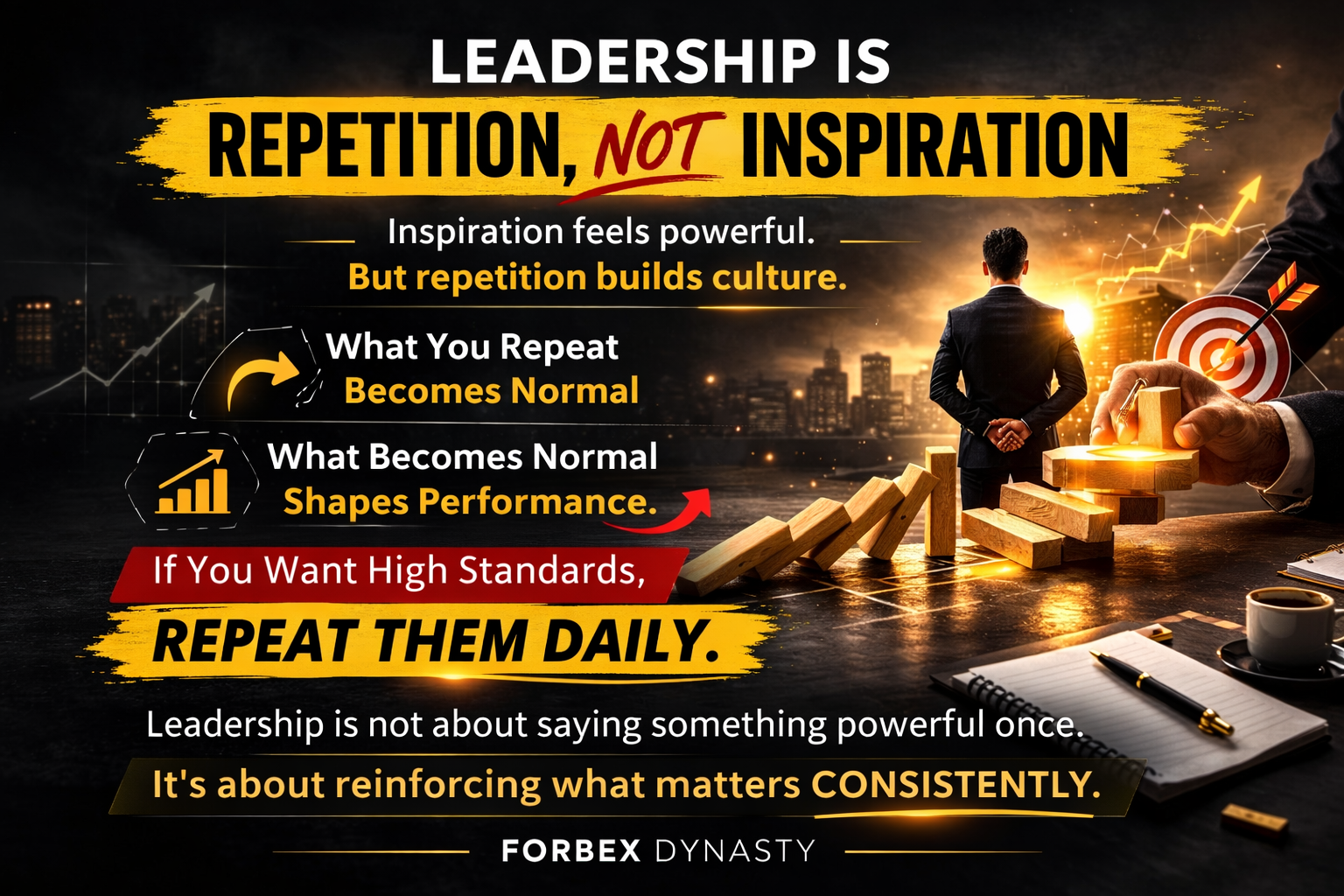
Leadership Is Repetition, Not Inspiration
Inspiration feels powerful.
But repetition builds culture.What you repeat becomes normal.
What becomes normal shapes performance.If you want high standards,
repeat them daily.Leadership is not about saying something powerful once.
It’s about reinforcing what matters consistently. -
From Manager to System Thinker
Managers control tasks.
System thinkers design outcomes.A manager asks,
“Did you finish it?”A system thinker asks,
“Why does this process fail?”Leadership evolves when you stop reacting
and start designing.If you are solving the same problems every week,
you don’t need more effort.
You need a better system.